

Every operating decision your company made last month has already produced a financial result. The order that shipped late, the safety stock that was raised "just to be safe," the reorder point nobody has revisited since go-live. Each one moved money. The only open question is when you will find out.
For most SAP-run enterprises, the answer is far too late. The decision happens in a transaction. The consequence appears in a quarterly review. In between sits a gap where real profit lives unclaimed. I call that gap latent profit, and it is the single most underestimated line item in a large manufacturing business.
Latent profit is earned value waiting on recognition
Latent profit is not theoretical upside, and it is not a rounding error hiding in a spreadsheet. It is value your business has already created through its own operating capacity, but has not yet converted into cash or margin because nothing in the reporting cycle prompted anyone to act.
That distinction matters. Chasing theoretical value requires a new strategy, a new system, or a new capital program. Capturing latent profit requires nothing new at all. It requires seeing what your existing SAP environment already knows, early enough to do something about it.
This is the point I made in a recent HelloNation feature and in the press coverage that followed. SAP is not concealing anything. It is simply answering the questions it is asked, on the schedule it is asked them.
SAP is the most honest witness in the building
SAP records what actually happened, transaction by transaction, in real time. That makes it the most reliable account of your operations anywhere in the company. It is also, in most organizations, the most underused.
Here is the catch. A system of record is passive by design. It will faithfully log a stock position that has not moved in fourteen months without ever raising its hand. It will execute a planning run against parameters that stopped matching demand three product cycles ago. Nothing is broken. Nothing is flagged. The data is correct and the outcome is still wrong.
Financial statements inherit that silence. By the time a margin decline is visible in a closed period, the operating conditions that caused it are already history. You are no longer managing performance. You are explaining it.
How executives recognize it
Latent profit rarely announces itself as a number. It shows up first as a pattern that operating leaders know well.
The warehouse is full and the product a customer is waiting on is short. Expedite freight becomes routine rather than exceptional. Teams work longer hours stabilizing service that should be stable on its own. Confidence in the system quietly erodes, and spreadsheets reappear alongside it to fill the gap.
None of that reaches a board deck. All of it is expensive. And every one of those symptoms is already visible in your SAP data on the day it occurs, well before it consolidates into a margin number that anyone reviews.
The clock is the real problem
Notice that none of this requires new technology to detect. What it requires is a different review cadence.
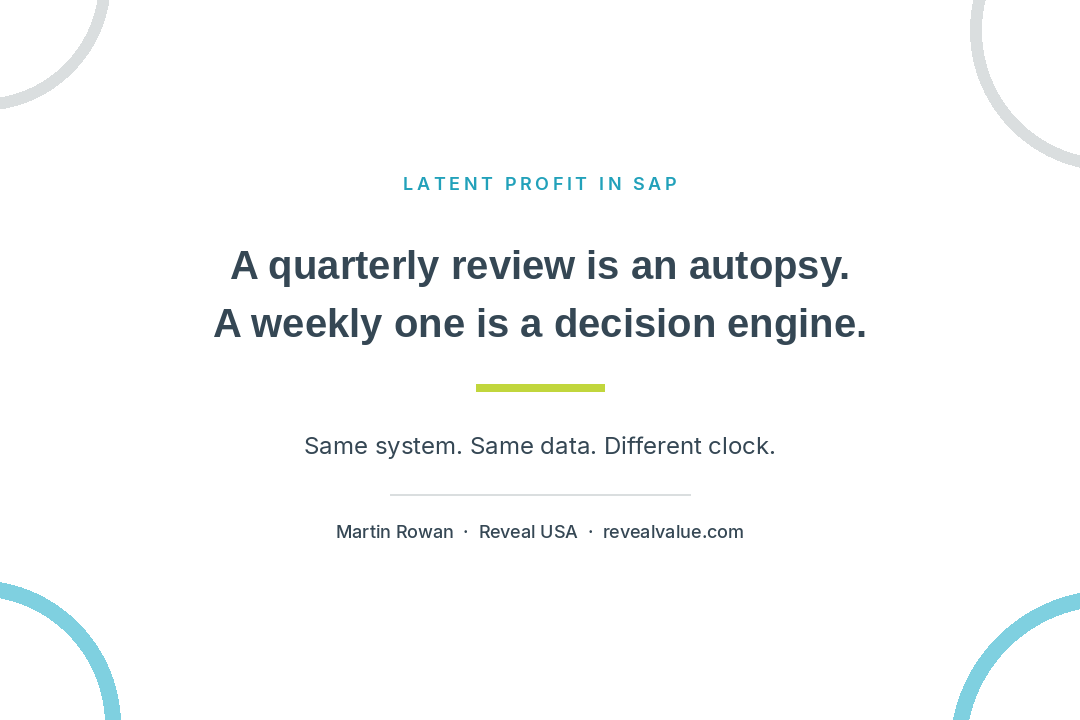
A quarterly performance review is an autopsy. It tells you what happened with precision and offers you no ability to change it. Shift the same review to a weekly or daily rhythm against live SAP data and it becomes something else entirely: a decision engine. Same system, same data, different clock, completely different economics.
That shift is what turns SAP from a record keeping obligation into an operating advantage. Thresholds get defined. Alerts fire on off-target planning and imbalanced stock. Someone specific is accountable for the response. Deviations are corrected in the week they occur, before they reach a customer, and long before they reach a P&L.
Governance is how you manage success
Execution governance carries an unfortunate reputation. People hear it and think of controls designed to stop bad things from happening. That framing sells it short.
Real governance is how you protect a result you have already earned. It keeps operating behavior aligned with financial intent as conditions change, and conditions always change. Demand shifts. Product mixes evolve. People move roles and take undocumented knowledge with them. Governance is the mechanism that keeps performance from drifting away from the plan the board already approved.
Companies that apply this consistently do not discover profit. They stop losing it. The value was always there in the operating capability they had paid for. What changed is that someone was watching in time.
The question worth asking this quarter
Nothing about SAP is keeping this value out of reach. The interval between when your business acts and when your business looks is what keeps it out of reach.
So the question for any executive accountable for margin, service, or working capital is not whether latent profit exists in your operation. It does. The question is how much of it your current review cadence allows you to reach before it expires.
That is a conversation worth having with live data on the table rather than a closed quarter. If you want to know what the number looks like inside your own SAP environment, that is exactly where we start.
About the author
Martin Rowan is Managing Partner of Reveal USA, Inc., based in Illinois. Reveal is an execution-led performance partner for SAP-run enterprises, helping manufacturers convert underperforming execution inside their existing SAP environment into measurable financial results.
Further reading
- How Hidden Profit Accumulates Inside SAP Before Margins and Service Decline, featuring Martin Rowan in HelloNation
- Press release: In HelloNation, Business Strategy Expert Martin Rowan, Reveal USA, Breaks Down How Latent Profit Hides in SAP Systems
- In HelloNation, Martin Rowan Details How SAP Misuse Impacts EBITDA and Enterprise Value
- In HelloNation, Martin Rowan Breaks Down SAP Underperformance Risks

