

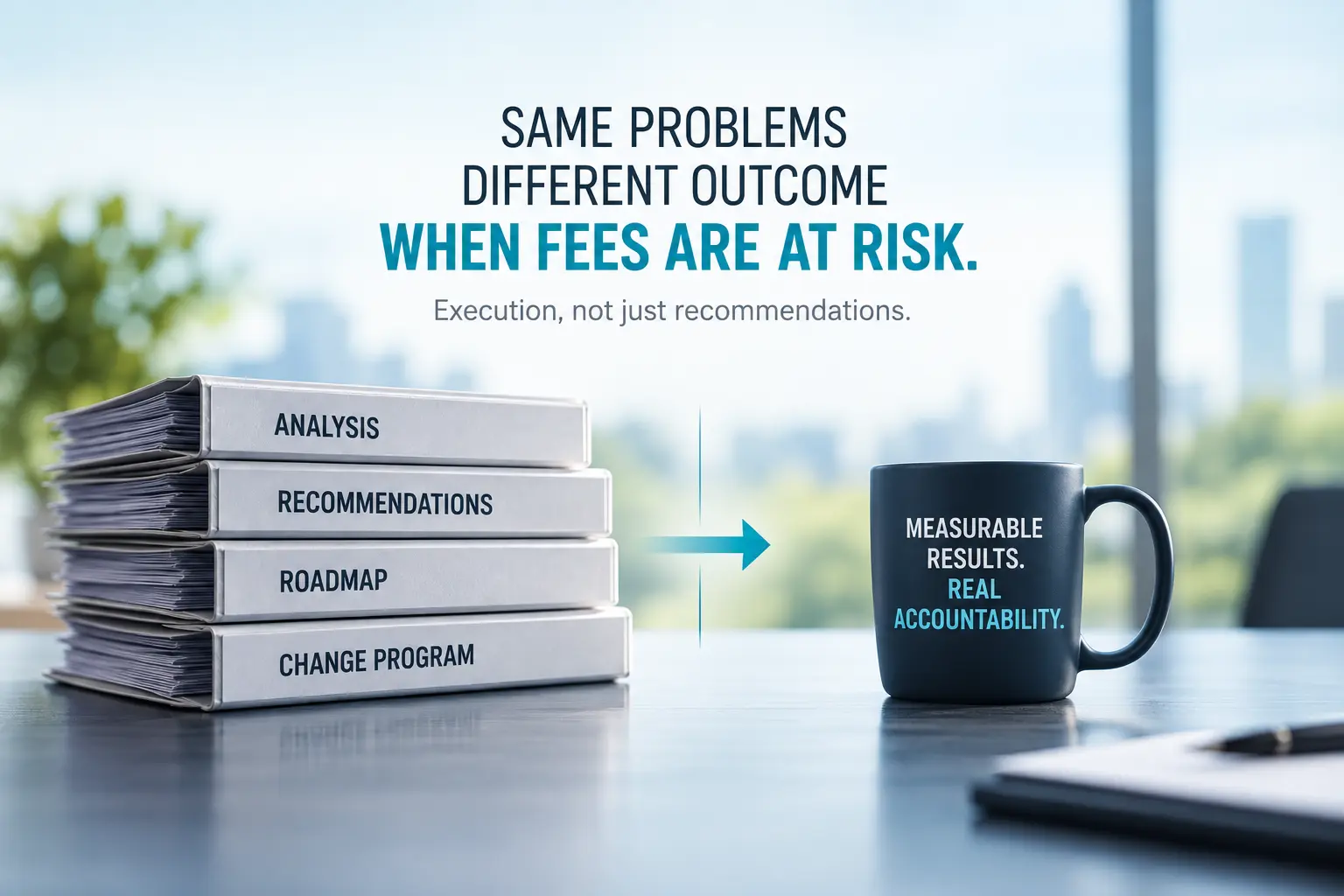
Most improvement programs deliver analysis, recommendations and roadmaps while leaving the client carrying all of the execution risk. If the improvement never materializes, the engagement still concludes as planned. That structure, not a lack of insight, is why performance gaps inside SAP persist for years.
Executive skepticism about improvement programs is rational and usually earned. Something similar has been tried before. It was broad, it was slow, and its results were hard to measure. The organization absorbed the disruption and the numbers moved less than the business case said they would.
The instinct after that experience is to blame execution discipline or the specific firm involved. The more useful explanation is structural.
What does a traditional engagement actually deliver?
Four things: analysis, recommendations, a transformation roadmap and a change program.
All four have value. None of them is a financial outcome.
The model optimizes for activity, because activity is what the model can guarantee. The workshops run. The current state is documented. The future state is designed. The roadmap sequences the work. Every deliverable arrives on schedule.
Then the client executes. If the improvement materializes, the business benefits and the engagement is judged a success. If it does not, the engagement still concluded as planned, the deliverables were still delivered, and the responsibility for the outcome sits where it always sat.
For an executive accountable for EBITDA, service performance and working capital, that is an uncomfortable arrangement. The advisor carries reputational risk. The business carries financial risk.
Why does insight not solve it?
Because insight was rarely the missing ingredient.
Most organizations already know something is wrong. Service instability, excess inventory and margin erosion are not subtle. Operations leaders can usually name the problem areas without any external help, and frequently have, more than once.
The gap is not knowing what to do. It is execution certainty: confidence that the correction will actually happen, will hold, and will produce the number it promised. Without that certainty, correcting execution feels riskier than tolerating the drift, so the drift continues. Quarter after quarter, in businesses run by capable people doing the best they can with the resources they have.
What goes wrong at the point of execution?
Three recurring failures, all visible in Reveal's published engagements before the work started.
- The recommendation never reaches the decision. A new process is designed, documented and trained. The decision continues to be made in a spreadsheet beside the system, so the process change is theoretical.
- The team reverts. Loparex had implemented S/4HANA across four facilities and watched teams revert to legacy workarounds rather than use the new planning and scheduling capability. The system was live. The old behavior was intact. The published turnaround came from embedded practical training, refined master data settings and activated reporting, not from another design phase.
- Nothing is left behind that holds. A cleanup improves the numbers, the engagement ends, parameters drift again, and within a year the position has rebuilt. This is why one-time data remediation does not stick and why governance is not an optional final phase.
What changes when the advisor carries the risk?
The economics change, and the economics determine the behavior.
Reveal guarantees an 8x financial return within 12 months. Clients make a fixed investment, and if the guaranteed return is not delivered, the investment is refunded. Once the guarantee is achieved, compensation moves to a contingent model based on an agreed percentage of the incremental value that continues to be delivered.
That structure removes several familiar failure modes automatically:
- Scope stops expanding, because unbilled scope costs the party carrying the risk.
- Low-yield initiatives get eliminated rather than added, because they consume execution capacity without moving the number.
- The work happens inside the business rather than beside it, because a recommendation that does not get adopted produces no return.
- The diagnostic has to be honest. If the path to 8x is not there, saying so early is cheaper than discovering it later. That is why the client pays only for the diagnostic in that case.
Because financial risk is carried, only a limited number of organizations are taken on each year. That is a constraint, and it is the direct consequence of the model rather than a positioning device.
What to ask any firm proposing an improvement program
Three questions, and the third is the one that separates models.
- What financial outcome are you committing to, expressed in service, margin or working capital?
- How was that number derived from our data rather than from benchmarks?
- What happens to your fees if it does not materialize?
An answer to the third question that involves shared learning, partnership or a commitment to the process is an answer that the risk stays with you.
The honest caveat
Outcome-based engagement is not always the right first step. Governance structures, board timelines or internal readiness sometimes make a project-based engagement the sensible way to begin, and many of the strongest outcome-based partnerships started exactly there.
The difference is worth stating plainly rather than hiding. Project-based work delivers operational improvement. Outcome-based work delivers guaranteed financial results. The scope of accountability is not the same.
Ask what happens to our fees if the results do not arrive. Request an executive conversation.

