

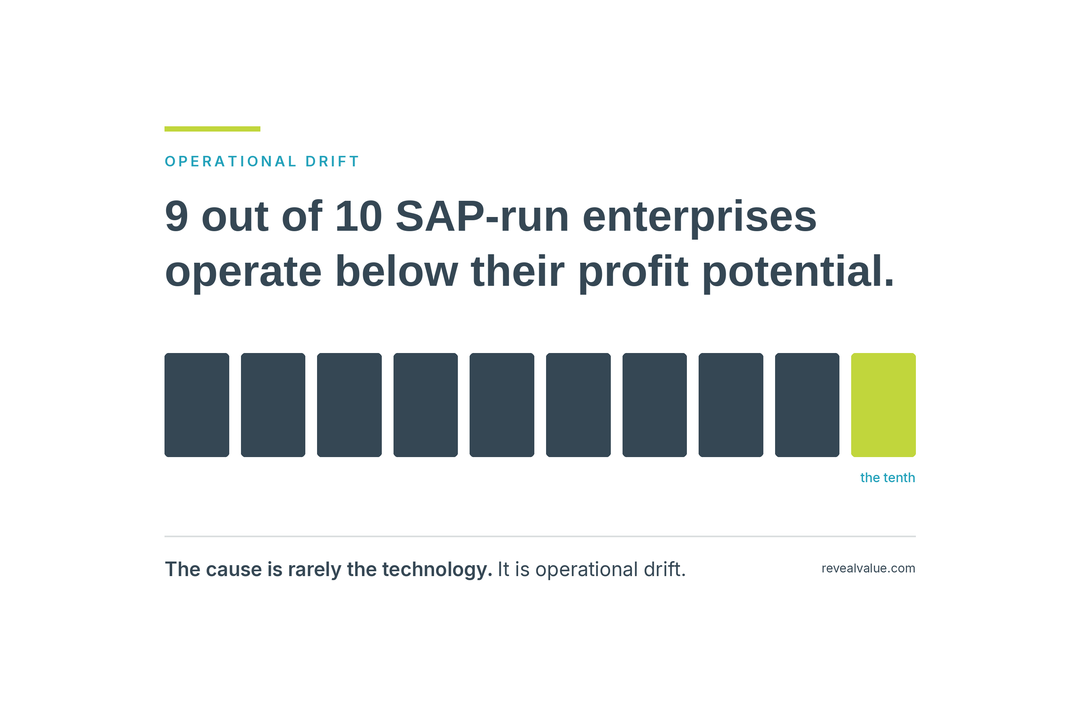
9 out of 10 SAP-run enterprises operate below their profit potential. The cause is rarely the technology. It is operational drift: processes diverging from best practice, workarounds multiplying, and planning decisions disconnecting from financial impact. Correcting drift starts with a data-led diagnostic that quantifies the gap, not with a transformation roadmap.
Most executives running SAP already suspect there is money left in the system. Service is less stable than it should be. Inventory is higher than the plan called for. The team is busy in a way that does not feel productive. None of this is invisible.
What is missing is not awareness. It is a number.
Why does an SAP investment stop producing a return?
Companies invest in SAP to enable growth, protect margins, and free up working capital. In most environments it is doing the first job well and the other two partially. The system posts transactions accurately, closes the month, and satisfies the auditors. That is a system of record working correctly.
The financial return depends on something else: whether the decisions that determine service levels, inventory, and margins are actually being made in the system. Over time, they drift out of it.
- Processes diverge from the standard the business was designed around.
- Workarounds multiply, each one reasonable on the day it was created.
- Licensed SAP capability sits unused because nobody trusts it enough to switch it on.
- Inventory decisions become disconnected from their financial consequences.
This is operational drift. It can be hidden, it is cumulative, and it creates strategic drag on growth, margin, working capital, and the ability to execute a strategy that the board has already approved.
What does the drift actually cost?
In large SAP enterprises the trapped value often runs to tens or hundreds of millions of dollars. That is not an abstraction. It shows up as unstable service that constrains revenue, inefficiency that erodes margins, working capital trapped in inventory, and sliding return on capital.
Campbell's Soup Co. is a published example of what the correction is worth when the drift is properly identified. Ballooning raw material and finished goods inventory, limited confidence in MRP, misaligned master data, and heavy manual expediting. The Reveal engagement produced $53M in total savings, $40M of it in the first year, alongside a 39% reduction in inventory and a 38% improvement in inventory turns.
The value was not created. It was already in the business. It was being consumed by drift.
Why do improvement efforts fail to find it?
Because most start with an opinion rather than the data.
A workshop produces a list of problems everyone in the room already knew about. A maturity assessment benchmarks the organization against a model. A roadmap sequences initiatives over three years. All of it is activity, and none of it tells the CFO what the opportunity is worth.
An honest diagnostic answers a narrower and far more useful question: given how this business currently runs inside SAP, what is the specific financial gap between current performance and achievable performance, and where exactly does it sit?
That question is answerable from live operational data. It does not require a maturity model or a benchmark set. It requires reading what the system is actually doing.
What does a real diagnostic look at?
Four things, in order.
- Where the money is trapped. Excess and obsolete stock, over-buffered fast movers, and the parameters producing them. This is usually the largest single pool.
- Where service is breaking. Not the fill rate number, but the specific failures behind it. Overdue supply elements, negative days of supply, exception messages nobody is working, and promise dates set from assumption rather than system data.
- Where the decision is being made. Whether planners accept what the system proposes or override it, and how often the override is right. This is where the shadow spreadsheet layer becomes visible.
- Whether the gap supports the investment. The point of quantifying the opportunity is to decide whether it is worth acting on. If the numbers do not support the return, that is a valid and useful answer.
What executives should ask for instead of a roadmap
If you are being asked to fund an improvement program, three questions separate a diagnostic from a discovery phase:
- What is the quantified financial opportunity, expressed in service, margin and working capital, and how was it derived from our data rather than benchmarks?
- Which specific constraints produce it, and who owns each one
- What happens if the opportunity does not materialize?
The third question is the one that matters. In the traditional model, the client carries the execution risk. The analysis is delivered, the recommendations are sound, and if the improvement never arrives the engagement still concludes as planned.
Reveal's diagnostic is built to answer all three. We use your live SAP data to identify where drift is creating strategic drag, quantify the value available, and validate whether it supports an 8x financial return within 12 months. If we cannot see the path to 8x, we say so, and you pay only for the diagnostic.
Where to start
You do not need a program to find out whether this applies to your business. Start with the twelve-question self-assessment. It takes a few minutes and returns a tailored report identifying where inefficiencies are most likely concentrated in your environment and three actions worth taking.
9 out of 10 is a statement about the population. The only question that matters is whether your business is the tenth.
Find out what your SAP environment is worth. Request an executive conversation.


