

After go-live, the war room empties, the invoices are settled, and the executive team asks: What’s changed? What did we get for all of that investment?
Too often, the answer is limited to compliance, speed and a modern ERP user interface.
Inventory and service levels look much as they did before, and month-end takes just as long. By week three, planners who were promised a better way of working are back in their spreadsheets, while the sponsor who presented the ROI is explaining to the board why the numbers have not moved.
The migration did not fail. It did what a migration does. It moved your business onto a new platform and left your working habits just as they were.
Greenfield or Brownfield?
Ask ten executives how they reached S/4HANA and you will hear greenfield, brownfield, or a hybrid selective transfer. For some organizations, the priority is a brand new clean system starting with a clean core and reeducating all team members. It’s a reset. For others, they just want to get through this with the least impact to the business so the goal is a Day 1 that looks just like today. Many take the middle road: a standard template, a selective migration of their own data, some customization kept, a good deal of old baggage shed on the way.
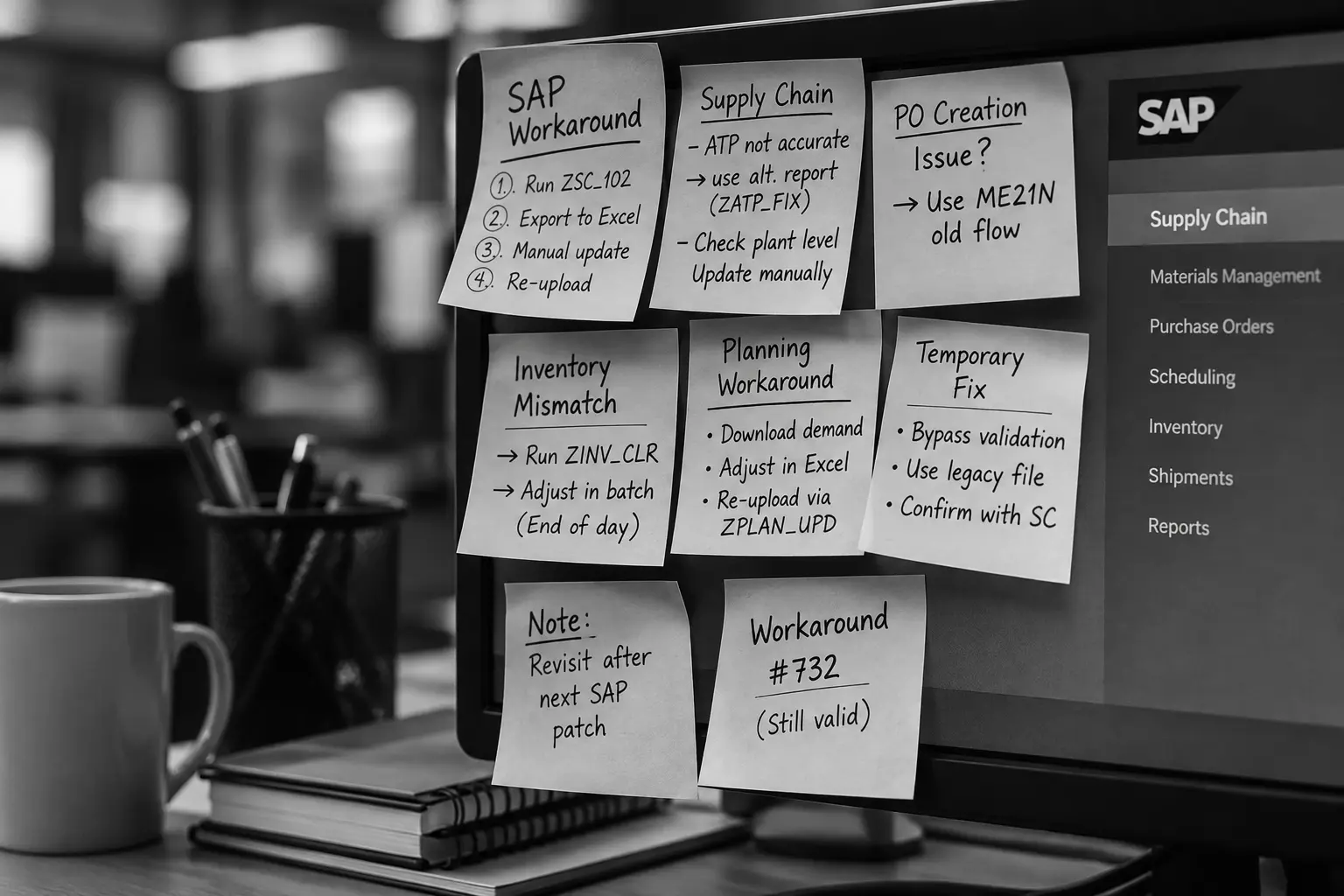
If you brought your data, you also brought the business rules, workarounds, and habits of the people who built them. The platform may be new, but the decisions remain the same.
What you actually bought
Most companies underestimate what changed with S/4HANA. It is not simply a version upgrade; it is a materially different solution with capabilities that were not available in ECC, many of which are delivered ready to use. And here’s the thing: S/4HANA is no longer new. It may just be new to you.
S/4HANA gives operations a more integrated view of the supply chain and makes the impact of a decision easier to see before action is taken. Instead of asking team members to search across reports, the system can direct relevant information and exceptions to the people responsible for acting on them. That only improves performance when trusted data, clear process flows, and in-system guidance help teams make better decisions and manage exceptions proactively.
The capability is technically there, yet in most businesses very little of it gets put to use. The company pays for a new solution and continues to run it like the one it replaced. That untapped capability represents a significant source of value that the business has not yet realized. And it’s a very expensive investment for more of the same.
What the migration delivered, and what it left alone
Delivered. A stable, supported foundation for the business community, with working transactions, security in place, and new capabilities ready to use. Uptime, completed test scripts, and the go-live date confirm that the system is live and the business can continue to operate. They do not tell you whether the investment is changing how the business performs.
Left alone. The operating conditions that determine whether the investment pays off: master data that still lacks clear business ownership, planning teams that still depend on spreadsheets, and functional handoffs that still break down between teams. Planners may know how to complete the transactions without understanding the cost of a parameter decision. This is where the impact becomes visible—in inventory turns, working capital, margin, and service levels.
What to watch for in the first year after go-live
- Service levels flat or declining while the team finds their feet
- Inventory and operating costs growing rather than improving
- Throughput stagnating despite the new layers of visibility
- Decisions still made outside the system, in spreadsheets, or 3rd party tools
- Teams manage every day as a crisis rather than using the system to identify and prioritize true exceptions.
- Team members trained to complete transactions without understanding how their decisions affect the business
- Limited business ownership of master data, so trust in SAP’s recommendations erodes again
- he business case starts to slip further out of reach
- You find yourself being pushed to look for a new tool to fix the one you just invested in
This is the implementation trap: protecting the go-live date can require deferring process, data, and capability work that is essential to value realization. That may be the right decision at the time, but the unfinished work often returns later as higher operating cost and unrealized financial benefit.
Why good enough allows drift to continue
Reveal has spent more than two decades working inside SAP-run businesses, often long after the original implementation. Across that experience, our analysis indicates that 9 out of 10 SAP-run enterprises operate below their profit potential. The pattern is consistent: processes move away from standard, workarounds multiply, capabilities go unused, and inventory decisions lose their connection to cash.
We call that Operational Drift. The business keeps moving, but decisions take longer, teams spend more time working around the system, and the strategy your board approved becomes harder to execute. Moving the same way of working onto new software will not fix the problem.
Drift persists because the system still closes the books and supports reporting, so there is little immediate pressure to ask for more. The familiar way of working feels safer, especially when teams have not been given the education and guidance to do things differently. Over time, that comfort with the status quo leaves financial and operational value unrealized.
Capturing the value
An S/4HANA program consumes capital, time, and employee goodwill. The fastest way to recover that investment is to convert the project results into financial results. It is easiest to tackle this while teams remain mobilized and the program still has organizational attention.
That is oVo Rapid Results. Using live SAP data, we identify the opportunity, focus execution on the constraints holding performance back, and work alongside your teams while the business continues to run. The engagement uses a fixed-fee model rather than hourly billing and includes a guaranteed 8x financial return within 12 months. If that return is not achieved, the investment is refunded.
Across more than two decades of delivery inside SAP run businesses, Reveal clients have achieved a 32% average improvement in service levels, a 17% average increase in inventory turns, and more than $1.2B in working capital released.
You already have the software. We bring the thoughtare.
Financial return is the first benefit. Lasting internal capability is the second. When a program this large leaves day-to-day performance unchanged after go-live, people understandably become skeptical that the next initiative will be any different. Momentum returns when teams can see that better data, stronger processes, and more effective use of SAP are producing better outcomes. That is the shift: the business should not work around SAP. SAP should work for the business.
Reveal does not implement SAP and is not a system integrator. We work shoulder to shoulder with your team members to build the operating framework, decision practices, and internal capability that improve performance. It is not about adding more technology. It is about helping the business put SAP to work.
Ready to Stop the Drift?
When good enough is no longer enough, it is time to get performance back on track. Reveal helps your teams stop Operational Drift and focus on the constraints holding the business back. Let’s start with a practical conversation about where performance is falling short and what it will take to close the gap.
Explore This Topic Further
Reveal provides SAP video learnings related to many topic. Check out this must-see example


