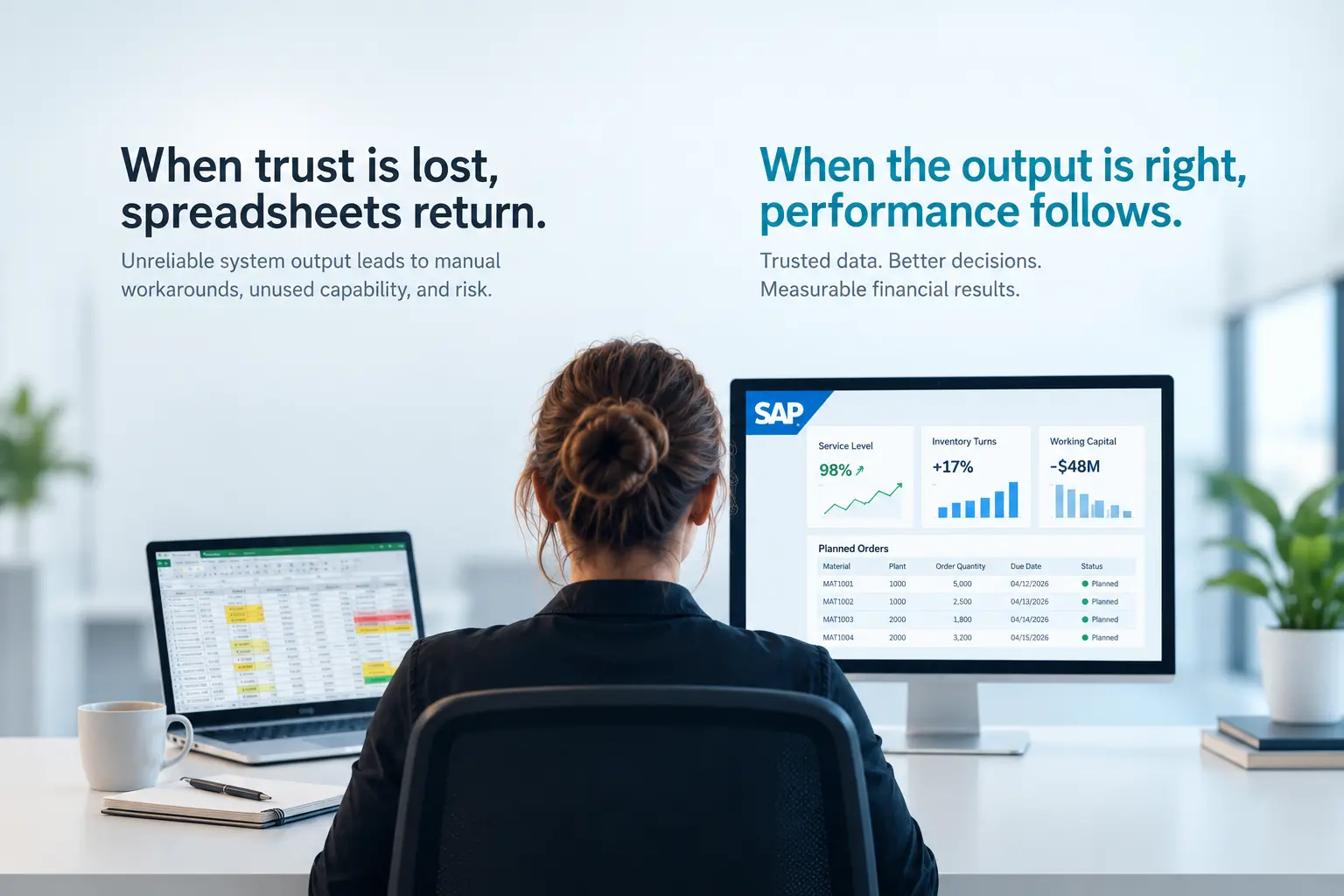
Trust in an enterprise system is not a cultural attribute. It is earned transaction by transaction and lost the same way. Once planners conclude that system output is unreliable, spreadsheets return, capability goes unused, and no amount of training restores confidence until the underlying data and settings are corrected.
Ask a planning team whether they trust SAP and you will get a diplomatic answer. Watch what they do on a Monday morning and you will get the real one.
If the first action of the day is to export data into a spreadsheet, the answer is no. And the reason is almost never that the team is resistant to technology.
How does trust actually get lost?
Through a sequence that is entirely rational at every step.
The system proposes something wrong. A lead time in the material master is fiction, or a safety stock parameter was set for a different demand pattern, or master data fields were repurposed years ago for a reason nobody documented. A planner spots it, overrides it, and is right.
That happens again. And again. The planner learns, correctly, that the output requires checking. Checking becomes a parallel calculation. The parallel calculation becomes the number the team works to. The system becomes a place where transactions are recorded after the real decision has been made elsewhere.
At no point did anyone behave unreasonably. The organization simply built a second planning system out of spreadsheets, and it did so as a rational response to unreliable output.
Why does training not fix it?
Because training addresses capability, and this is a credibility problem.
You can teach a planner exactly how the exception monitor works. If the exception queue is full of noise generated by bad data, the planner will finish the training, look at the queue, confirm that most of it is not actionable, and go back to the spreadsheet. The training was accurate and the conclusion was correct.
This is why enablement without data correction produces short-lived results, and why so many organizations have run the same SAP training twice.
One global wine producer is instructive here. The challenge was not skills. It was siloed systems, data flow breakdowns, a lack of trust in data, and manual workarounds preventing data-driven decisions. The approach that worked focused on education, cross-functional alignment and consistent execution rather than adding new tools, and it embedded a governance model so the improvement had something to hold it in place. Overdue MRP supply elements fell 96.6% on raw materials and 98.4% on finished goods, with slow moving finished goods stock down 48.2%.
What are the costs of a low-trust system?
Four, and none of them appear as a line item.
- Decisions run on ungoverned data. The spreadsheet has no master data controls, no audit trail and no owner. It frequently has no backup.
- Improvements do not reach the decision. Money spent improving the system produces no operational change, because the decision is being made outside it. This is the most expensive item on the list and the hardest to see.
- Knowledge concentrates in individuals. The person who built the planning workbook understands the logic. When they leave, the logic leaves. One long-established equipment manufacturer was working offline in Excel with custom transactions and third-party tools, and had master data fields repurposed in ways that restricted future capability.
- Licensed capability stays switched off. Available to Promise, material availability checking, scheduling functionality: all paid for, all dormant, because nobody trusts the inputs enough to rely on the output.
How is trust rebuilt?
Not by asking for it. By making the output right and letting people verify it themselves.
Correct the data first. Lead times, lot sizes, safety stocks and planning parameters that reflect how the business runs now. Until this is done, everything else is a communication exercise.
Let the team prove it. Run the corrected logic alongside the spreadsheet on real operational scenarios. When the system's answer matches or beats the manual one repeatedly, the argument makes itself. That manufacturer's turnaround began with documenting current processes against the SAP standard and piloting the standard process, which is exactly this.
Involve the people who will use it. A parameter set configured for planners rather than with them inherits no credibility.
Govern it so it holds. Parameters drift. Without ownership, a review cadence and someone accountable for keeping settings aligned to reality, the spreadsheets come back, and the second return is harder to reverse than the first because the organization now has evidence that the fix does not last.
What leaders should watch for
Not survey scores. Behavior.
- What percentage of system-proposed orders are accepted without modification?
- How many parallel planning spreadsheets exist, and who maintains them?
- Which licensed capabilities are switched on but unused?
- When someone new joins, are they trained on the system or on the workaround?
That last question is the clearest signal available. If the informal process is what gets taught, it is the real process, and the system is documentation.
The 12-question self-assessment will give you a read on where reliability is breaking down in your own environment.
Rebuild confidence in the system you already own. Request an executive conversation.